A Core Focus at Next IT Security | Stockholm 2026
Introduction
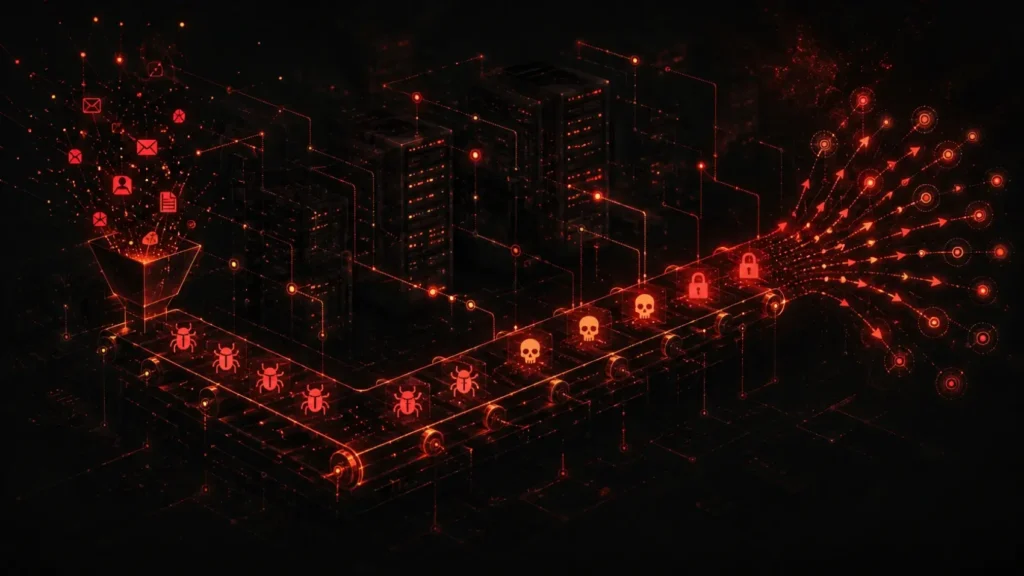
Cybercrime has evolved far beyond isolated hackers operating independently. Today, it has become a highly organised global ecosystem driven by professionalisation, specialisation, and commercialisation. Criminal groups increasingly operate like legitimate businesses, offering services, tools, and expertise that enable even individuals with limited technical knowledge to launch sophisticated cyberattacks.
Recognising the significant impact this transformation has on organisations worldwide, The Industrialisation of Cybercrime has been identified as one of the core focus areas at Next IT Security | Stockholm 2026. As emerging technologies—particularly artificial intelligence—continue to reshape the cyber threat landscape, organisations must better understand how cybercriminal operations are evolving and what strategies are needed to strengthen resilience against increasingly advanced attacks.
Why this matters now
The cyber threat landscape is becoming increasingly complex as cybercriminal organisations adopt business models that mirror legitimate commercial enterprises. Services such as Ransomware-as-a-Service (RaaS), Phishing-as-a-Service (PhaaS), Malware-as-a-Service (MaaS), and other Crime-as-a-Service offerings have significantly lowered the barrier to entry for cybercrime.
Artificial intelligence is accelerating this evolution by enabling attackers to automate reconnaissance, generate highly convincing phishing campaigns, develop sophisticated social engineering techniques, and scale attacks with unprecedented speed and efficiency.
At the same time, cybercriminals are expanding beyond purely digital operations. Emerging concepts such as Violence-as-a-Service demonstrate how cyber-enabled criminal activities are increasingly intersecting with physical threats, creating new risks for organisations, governments, and critical infrastructure.
For these reasons, Next IT Security | Stockholm 2026 will explore how organisations can better understand the industrialisation of cybercrime while strengthening their ability to anticipate, prevent, and respond to evolving threats.
The Rise of Crime-as-a-Service
One of the defining characteristics of modern cybercrime is its growing service-based economy. Criminal groups now specialise in specific parts of the attack lifecycle, offering ransomware platforms, exploit kits, credential marketplaces, initial access brokerage, and extortion services to affiliates worldwide.
This commercialisation has created a scalable ecosystem where attackers can purchase ready-made capabilities instead of developing them independently. As a result, cyberattacks have become more accessible, more frequent, and more sophisticated.
Impact on Next-Generation IT Security
As Crime-as-a-Service continues to mature, organisations are increasingly focusing on:
- Understanding cybercriminal business models and attack ecosystems.
- Strengthening identity and access management.
- Enhancing threat intelligence and cybercrime monitoring.
- Improving ransomware preparedness and recovery capabilities.
- Increasing collaboration across security operations and incident response teams.
Discussions at Next IT Security | Stockholm 2026 will examine how defenders can disrupt increasingly professional cybercriminal operations before attacks succeed.
Artificial Intelligence: Accelerating the Threat Landscape
Artificial intelligence represents one of the most significant technological shifts affecting cybersecurity today. While AI delivers enormous opportunities for defenders through automation and improved detection capabilities, it also provides cybercriminals with powerful new tools.
Attackers can leverage AI to generate convincing phishing emails, create realistic deepfake content, automate vulnerability discovery, develop malicious code more rapidly, and personalise attacks at scale. These capabilities significantly reduce the time and effort required to launch successful campaigns.
As AI becomes increasingly accessible, organisations must prepare for a future where attacks are faster, more adaptive, and significantly more difficult to detect.
Impact on Next-Generation IT Security
The increasing use of AI is driving organisations to:
- Integrate AI-powered detection and response capabilities.
- Improve resilience against AI-generated phishing and social engineering.
- Develop governance frameworks for responsible AI adoption.
- Strengthen employee awareness of AI-enabled deception techniques.
- Continuously evaluate emerging AI-related cyber risks.
At Next IT Security | Stockholm 2026, industry experts will explore how organisations can safely embrace AI while defending against its misuse by cybercriminals.
From Digital Crime to Physical Consequences
Modern cyberattacks increasingly extend beyond financial theft or data compromise. Criminal organisations are strategically targeting critical infrastructure, healthcare, transportation, manufacturing, and supply chains where disruption can create widespread societal and economic consequences.
The emergence of concepts such as Violence-as-a-Service highlights the growing convergence between digital attacks and physical harm. Cyber-enabled criminal activity can now facilitate extortion, intimidation, sabotage, and coordinated operations that blur the boundaries between cybercrime and traditional organised crime.
This evolution demands a broader approach to cybersecurity that considers both digital resilience and operational continuity.
Impact on Next-Generation IT Security
Organisations are increasingly prioritising:
- Protection of critical infrastructure and operational technology.
- Supply chain cybersecurity and third-party risk management.
- Business continuity and crisis management planning.
- Cross-sector threat intelligence sharing.
- Integrated cyber and physical security strategies.
Next IT Security | Stockholm 2026 will examine how organisations can prepare for increasingly interconnected threats affecting both digital and physical environments.
International Cooperation and Collective Defence
Cybercrime operates without geographical boundaries, making international cooperation essential. No single organisation, industry, or government can address today’s cyber threats independently.
Public-private partnerships, cross-border intelligence sharing, law enforcement collaboration, and coordinated incident response have become fundamental components of modern cybersecurity. Building resilience requires cooperation between governments, technology providers, private organisations, academia, and security communities.
The future of cybersecurity depends on creating stronger collaborative ecosystems capable of responding to increasingly organised and sophisticated cybercriminal networks.
Impact on Next-Generation IT Security
Organisations are strengthening resilience by:
- Participating in threat intelligence sharing initiatives.
- Expanding public-private cybersecurity partnerships.
- Improving international incident response coordination.
- Aligning with evolving regulatory and security frameworks.
- Building collaborative resilience across industries and supply chains.
Experts at Next IT Security | Stockholm 2026 will discuss how collective defence strategies can strengthen resilience against an increasingly borderless cyber threat landscape.
Why It Is a Core Focus Area at Next IT Security | Stockholm 2026
The Industrialisation of Cybercrime has been selected as a core focus area because cyber threats are no longer isolated technical incidents—they have become organised, scalable, and commercially driven operations that affect organisations across every sector.
As cybercriminals continue adopting advanced technologies such as artificial intelligence while expanding service-based criminal ecosystems, organisations must evolve beyond traditional security approaches. Prevention, preparedness, intelligence sharing, and international collaboration are becoming essential elements of effective cyber resilience.
To further explore these rapidly evolving threats, attendees will gain valuable insights from keynote presentations and expert discussions covering AI-driven cybercrime, Crime-as-a-Service ecosystems, emerging physical-digital threat convergence, ransomware evolution, supply chain security, and collaborative defence strategies.
These discussions will demonstrate why understanding the industrialisation of cybercrime has become a strategic priority for security leaders worldwide.
Looking Ahead
The future of cybersecurity will be shaped by the ongoing evolution of organised cybercrime. Artificial intelligence, automation, and increasingly specialised criminal services will continue to transform how attacks are planned, executed, and monetised.
Organisations that invest in proactive defence, intelligence-led security strategies, workforce readiness, and international collaboration will be better positioned to anticipate emerging threats and maintain long-term resilience.
As one of the core presentation areas at Next IT Security | Stockholm 2026, The Industrialisation of Cybercrime will provide attendees with valuable insights into the rapidly changing cyber threat landscape while exploring practical strategies for strengthening resilience in an increasingly connected and complex digital world.